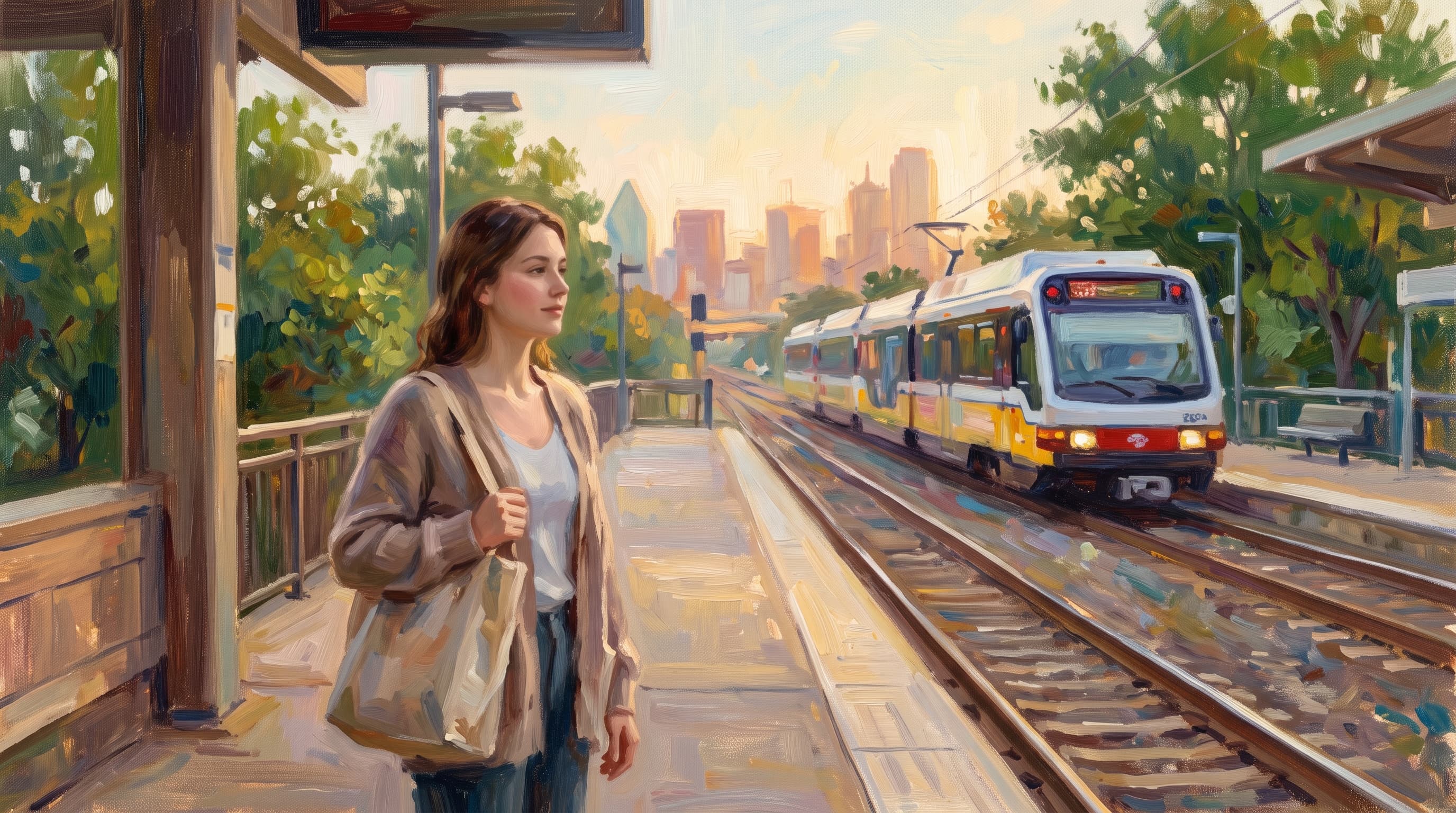

It's 7:40 on a Tuesday and I'm standing on a DART platform with a cold brew going warm in my hand, watching the train slide in. I don't own a car. Six months ago that sentence would have scared me. This morning it just feels like my life.
Here's the thing nobody tells you before you move to Dallas: this is a car city. It was built for cars, zoned for cars, spaced out for cars. When people say "you need a car in Dallas," they're not being dramatic. They're mostly right.
But "mostly" is doing a lot of work in that sentence. And where you land changes the whole answer.
The honest version: can you really live in Dallas without a car?
Let me not sell you a fantasy. Dallas is not New York. You cannot move here, skip the car, and expect the city to meet you halfway everywhere you go.
If your job is in Plano or Irving or one of the suburban office parks, and you don't live near a rail line, you're going to be stranded in the specific way that eats your weekends. Groceries become a whole plan. A dinner across town becomes a math problem. The freedom you imagined starts to feel like a cage with good weather.
I know that version because I almost lived it. I signed nothing for the first month and I'm glad I didn't.
What changed for DART in 2026
If you're moving this year, there's a wrinkle worth knowing about. DART, the regional transit system, is in the middle of a real fight. Several suburbs have been trying to pull their funding, and there's genuine uncertainty about how much service holds and where. It made the Texas Tribune in January and it hasn't quietly resolved.
What that means for you is simple and a little annoying: the map matters more than ever. The core lines through downtown are the strong part of the system. The further out you count on it, the shakier the bet.
So the move isn't "can I live car-free in Dallas." The move is "can I land somewhere the strong part of the system actually reaches." Those are different questions, and only one of them has a good answer.
The money: what going car-free in Dallas actually saves
You are probably doing the math, so here it is. A monthly DART pass runs $126. Going without a car saves most people north of $500 a month once you add up the payment, insurance, gas, and the quiet violence of Dallas parking.
That's real money. In a city where a one-bedroom in Uptown is pushing $2,300 and even better-priced Deep Ellum sits closer to $1,770, five hundred dollars a month is the difference between comfortable and counting.
But I want to be honest about the number that actually mattered to me, and it wasn't on the spreadsheet.
The hidden cost of car-free living nobody budgets for
The real risk of going car-free in a car city isn't inconvenience. It's isolation.
When getting anywhere takes effort, you do less. You skip the coffee thing. You don't go to the second hangout. You tell yourself you'll go next week, and next week the train is a reason not to. Slowly your world shrinks to the radius you can reach without thinking about it, and if that radius is your apartment and a grocery store, you get lonely in a way that has nothing to do with transit.
I've watched it happen to people who moved here with more money and a nicer car than me. A vehicle doesn't fix it. Being close to your life fixes it.
What actually makes car-free Dallas work
So here's what I'd tell a friend flying in next month with no car and a new job.
Car-free in Dallas works when two things are true at once. You live near the strong part of the transit map, and you live near people. Not one. Both.
The transit part gets you to work and to the city without a steering wheel. Deep Ellum, where the Blue, Green, and Orange lines meet, is one of the best-connected pockets in the whole metroplex, and it runs about 25% under Uptown rent. Neighborhoods threaded onto a rail line are the ones where this isn't a daily negotiation.
The people part is the one everyone forgets. If your Saturday plans don't depend on you, alone, deciding to leave the house and go find humans across town, you'll actually have a Saturday. When there are people where you already are, car-free stops meaning cut off. It just means you walk to more of your life.
Where a soft landing fits a car-free move
This is the part where coliving quietly solves a problem you didn't know to name.
Dali House sits in the category of "close to your life." It's a women-centered coliving home in Dallas, furnished, utilities handled, built for women landing in a new city. And the thing that makes it matter for a car-free move isn't the location alone. It's that there are already people in the kitchen.
You're not commuting to community. You're not driving to find it. On the mornings the train feels like too much, there's still a house with someone in it, someone who also just moved here, someone to split a ride to the lake with or walk to dinner with. Car-free stops being a story about what you gave up. It becomes a story about how little distance sits between you and the rest of your day.
That's the whole trick. Reduce the friction between you and your life, and you stop needing a car to feel like you have one.
Who car-free Dallas is actually right for
Not everyone. If your job sits deep in the suburbs and you love a road trip, buy the car, no shame in it.
But if you're moving to Dallas to work downtown or somewhere a rail line reaches, if the idea of a car payment on top of first-month-rent makes your stomach drop, if you'd rather spend that $500 on the life you moved here for, then car-free is not just possible. Done right, it's the softer landing.
The mistake is treating it as a transit decision. It's a location decision, and location, in a car city, is really a decision about how alone you're willing to be.
Land close to the strong lines. Land close to people. The rest works itself out, one warm train platform at a time.
Wondering if a car-free landing in Dallas could actually work for you? See if Dali House is the right fit.